


Little Fire
- About Us
- AI Robot Lab
- Store
- …
- About Us
- AI Robot Lab
- Store
Little Fire
- About Us
- AI Robot Lab
- Store
- …
- About Us
- AI Robot Lab
- Store
Empower Your Child with the Stanford Edge: Master Embodied AI & Robotics Live
Learn from Hunter, Stanford MSCS and ACM HRI 2023 Best Systems Paper Award winner. Our exclusive live sessions bring Silicon Valley’s cutting-edge Embodied AI and Space Computing labs directly to your child, transforming them from passive AI users into future innovators.
From Silicon Valley Labs to the Future: Embodied AI & Spatial Computing Workshop
Module 1: The Stanford Mindset & Embodied AI Foundations
Stanford PBL Logic: Learn the "Problem-Based Learning" methodology used in top-tier Silicon Valley labs to define and solve complex challenges.
• Why AI Needs a "Body": Introduction to Embodied AI—understanding how intelligence evolves when it interacts with the physical world.
Module 2: Spatial Computing & The Vision Pro Era
Apple Vision Pro Integration: Exploring the transition from 2D screens to 3D spatial environments.
• Gesture & Perception: Analyzing machine vision technology to create intuitive controls for robotic systems.
Module 3: Human-Robot Interaction (HRI) Masterclass
Best Systems Paper Deep Dive: Hunter deconstructs his award-winning research on how robots perceive and respond to human behavior.
• Hands-on Prototyping: Designing logic for robots to "understand" spatial commands and environmental cues.
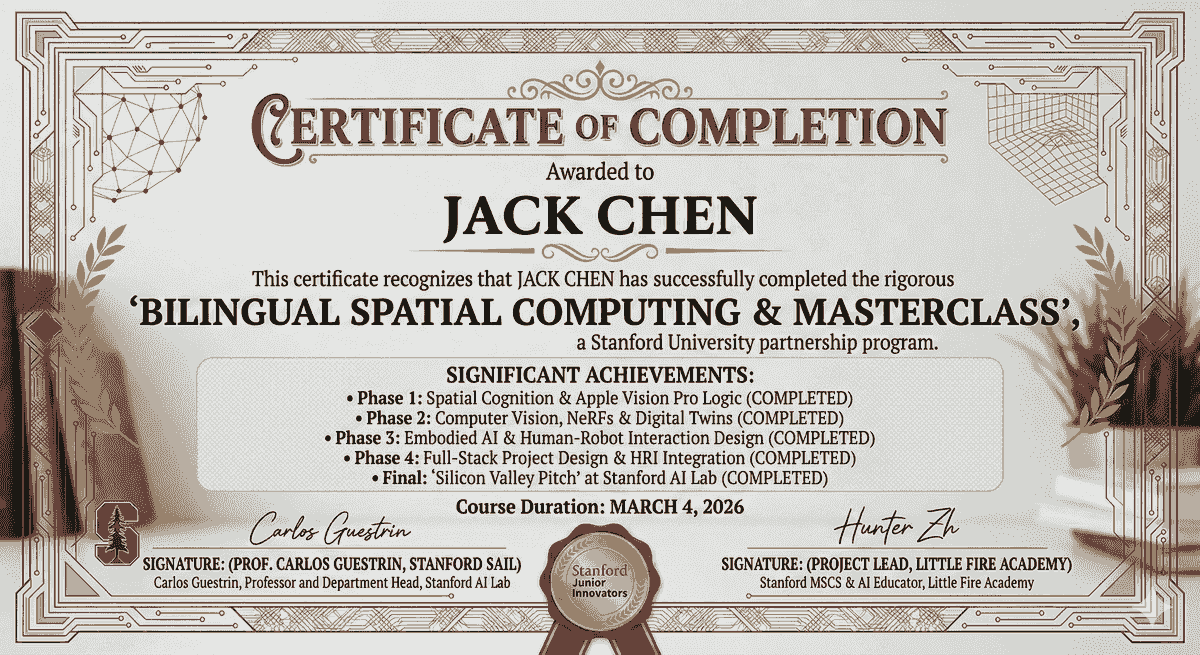
Stanford Junior Innovators
Spatial Computing & Embodied AI Masterclass
🎓 Learning Objectives
• Master Spatial Thinking: Move from 2D screens to 3D world interactions.
• Embodied AI Mastery: Understand why AI needs a "body" to interact with the physical world.
• Stanford PBL Logic: Apply the "Empathy-to-Prototype" framework to solve real-world problems.
Phase 1: Spatial Cognition & AR Foundations
Session 1: Hello, Digital Twin! — Opening the Door to Spatial Computing
• Scientific Principle: Understanding the leap from 2D (screens) to 3D (space). Defining "Spatial Computing."
• Hands-on Demo: Using an iPad/iPhone to scan a physical object (like an apple) and generate its digital model in mid-air.
• Stanford Mindset: "Observation Training"—Analyzing how light, shadows, and reflections affect objects in the physical world and simulating them in AR.
Session 2: The Magic of Gestures — Mastering Vision Pro Interaction Logic
Interaction Tech: Learning Apple's core interaction language (Tap, Pinch, Drag).
Toolbox: Using Reality Composer to set up "Tap Triggers"—making a virtual robot dance when you click a floating button.
Logic Training: Understanding the relationship between "Triggers" and "Actions" to build fundamental programming reflexes.
— Alice Johnson
Phase 2: Giving AI a "Body" (Embodied AI)
Session 3: Robots "Seeing" the World — Introduction to Computer Vision
• AI Core: Explaining how robots recognize objects via cameras and LiDAR.
• Practical Exercise: Setting up "Plane Detection" in AR to help the AI understand the difference between the "floor" and a "tabletop."
• Embodied AI Concept: Understanding that AI can only perform meaningful actions once it perceives its physical environment.
Session 4: Command Line Heroes — Programming Your First Robot Logic
Coding in Action: Using Swift Playgrounds (Apple’s official coding tool).
• Mission: Guiding a robot named "Byte" through a 3D obstacle course using precise code commands.
• Computational Thinking: Learning how "Loops" and "Functions" are used in real-world robotics control.
Phase 3: Human-Robot Interaction & Creative Design
Session 5: The "Emotions" of Robots — Designing Human-Robot Interfaces (HRI)
• Design Aesthetics: Learning Stanford D.School’s "Empathy-Driven Design." (e.g., What color should a robot’s eyes be to appear friendly?)
• Hands-on: Adding spatial audio and dialogue bubbles to your robot in Reality Composer.
• HRI Basics: Learning how to make robotic feedback feel more human to improve the user experience.
Session 6: Spatial Puzzles — Creating Your First AR Maze
- Integrated Project: Using the room's physical floor to layout a complex digital maze.
- Tech Point: Mastering "Physics & Collision Detection."
- Challenge: Programming the AI robot to autonomously find the fastest path out of the maze.
Phase 4: Future Vision & Project Showcase
Session 7: The Smart Agent — How AI Assistants Change Our Lives
• Tech Trends: Analyzing the logic behind "AI Agents" (like the popular OpenClaw) and how they automate tasks.
• Imagination Spark: If your robot "Twin" could do your homework or clean your room, what new skills would it need to learn?
• Career Outlook: Exploring 2026’s hottest roles: "Prompt Engineers" and "Spatial Designers."
Session 8: The Stanford Pitch — Presenting Your Spatial Robot Proposal
Presentation Skills: Learning the art of the "Elevator Pitch" for tech projects.
Portfolio Review: Organizing the AR works created in the previous sessions into a professional demo video.
Grand Finale Prep: Preparing questions for the Live Session with Hunter Zhang to secure personalized expert feedback.
Expert Live Session: Inside the
Silicon Valley Lab
Theme: From Stanford to the Future – Embodied AI with a Stanford Mentor
• Offline Location: Little Fire Mountain View Office (599 Fairchild Drive, Mountain View, CA)
• Online Access: Global Live Stream (Unlimited Regions)
• Participants: 2-6 Offline Students | 10+ Online Students | Ages 8-15Add subtitle
100-30 min: Live Lab Demo (The Dual-Perspective Experience)
The Experience: Hunter broadcasts live from the Little Fire Mountain View Office, demonstrating the latest in Embodied AI.
• Offline Students: Stand right next to the hardware, observing LiDAR sensors and robotic actuators up close.
• Online Students: Watch via a high-definition dual-camera setup (Main View + Robot’s POV).
• Interactive Demo: Demonstrating "Spatial Commands" by navigating a robot through physical obstacles set up by the offline students on-site.
230-60 min: Collaborative "Cloud-to-Physical" Mission
The Mission: Co-training an "AR Navigation Assistant."
• Online Students: Design AR waypoints on their screens and send logic parameters (speed, rotation, avoidance) to the lab.
• Offline Students: Act as "Field Engineers," placing physical barriers on the office floor to test if the online students' logic can successfully guide the robot.
• Learning Goal: Understanding how digital code crosses borders to control physical entities in a Silicon Valley lab.
360-90 min: Stanford Mindset & Roadmap
Silicon Valley Insights: Hunter shares his journey researching Embodied AI at Stanford and explains why Mountain View is the global heart of AI (neighbors with Google and Waymo).
• Academic Roadmap: Personalized advice for students aged 8-15 on building a competitive profile for top-tier universities and future tech competitions.
• Global Q&A: A round-robin session where offline and online students discuss the 2026 AI landscape and get expert feedback on their course portfolios.

Little Fire Corp